
What Is the Difference Between Antiskid Epoxy Flooring vs. ESD Epoxy Flooring?
Introduction
In modern industrial and commercial spaces, controlling static electricity is important—especially where electronic equipment, sensitive components, or electrical systems are involved.
Twoterms that are often used interchangeably are Antiskid Epoxy Flooring and ESD Epoxy Flooring. However, they are not necessarily the same. Understanding the difference helps you select the right flooring system for your application.
1. What Is Antiskid Epoxy Flooring?
Antiskid epoxy flooring is designed primarily to reduce the generation and accumulation of static electricity on the floor and on people walking across it.
The main objective is to prevent uncomfortable and reduce the possibility of static-related issues.
Common applications:
• Offices with sensitive electronic equipment
• Server and data-centre areas
• Control rooms
• Laboratories
• Electrical rooms
• Commercial and industrial spaces where static buildup needs to be reduced

2. What Is ESD Epoxy Flooring?
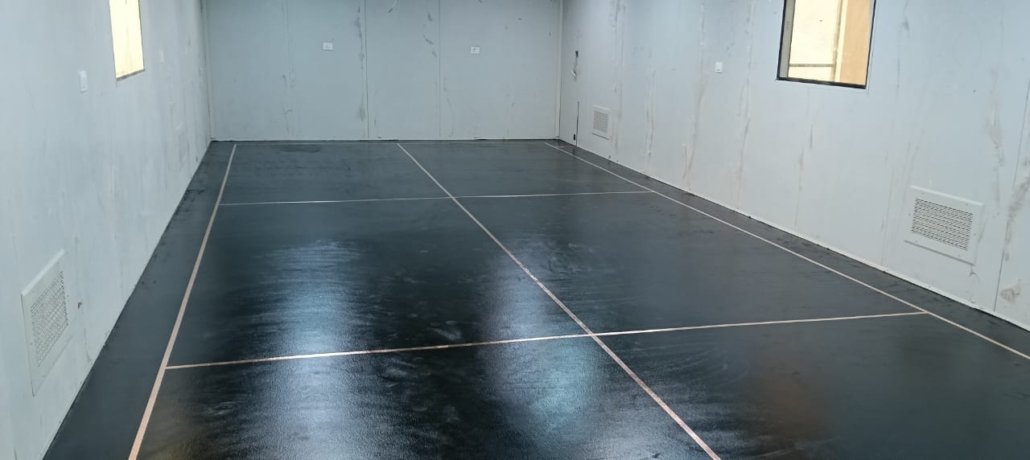
ESD stands for Electrostatic Discharge. ESD epoxy flooring is designed as part of a controlled static-dissipation system. Instead of simply reducing static buildup, the flooring provides a controlled path for electrical charge to move toward grounding.
ESDprotection is particularly important when working with electronic components that can be damaged by electrostatic discharge.
3. The Major Difference
Antiskid flooring focuses on reducing static charge generation. ESD flooring focuses on controlling and safely dissipating electrostatic charge.
ESDflooring is generally specified using measurable electrical resistance requirements and appropriate testing, rather than relying only on the word “antiskid”.
4. Antistatic Epoxy vs ESD Epoxy Flooring
| Feature | Antiskid Epoxy | ESDEpoxy |
| Main purpose | Reduce static buildup | Control and dissipate electrostatic charge |
| Static protection | Basic/static-charge reduction | Contro led static dissipation |
| Electrical resistance | May vary by system/specification | Defined and tested requirements |
| Grounding | May not be part of a complete ESD system | Important part of the system |
| Application | General static-control environments | ESD-sensitive environments |
| Protection level | General static control | More controled |
5.How Does ESD Epoxy Flooring Work?
Person / Equipment – ESD Floor – Conductive Path – Ground
Whenaperson walks acrossan ordinary floor, static electricity can accumulate. With an appropriately designed ESD flooring system, the electrical charge can be controlled and dissipated toward ground, reducing the risk of sudden electrostatic discharge.
ESD flooring normally works together with appropriate footwear, grounding and other elements of an ESD control program.
6. Where Is ESD Epoxy Flooring Used?
ESD flooring is particularly useful in areas where electrostatic discharge could damage products, equipment or processes.
• Electronics Manufacturing Units — Protect sensitive electronic components.
• PCB & Semiconductor Facilities — Reduce ESD risk to sensitive components.
• Laboratories — For sensitive electronic instruments and equipment.
• Server & Data Centres — Helpsmanage electrostatic risks.
• Cleanrooms — Canbeincorporated into controlled environments.
• Electrical & Testing Areas — Useful where static control is required.
7. Which One Should You Choose?
If your main requirement is to reduce static buildup and static shocks, an appropriately specified antiskid flooring system may be sufficient.
If you are working with ESD-sensitive electronic components or require a controlled ESD protection area,an appropriately designed and tested ESD epoxy flooring system is generally the more suitable approach.
The important thing is to specify the required performance and testing—not simply ask for an “antiskid floor”.
8. Why Professional Installation Matters
ESDflooring is more than simply applying a special epoxy coating. A professional system may involve:
• Proper surface preparation
• Conductive/ESD primer or layer
• Copper grounding network where required
• ESD epoxy layers
• Correct grounding connection
• Proper installation procedures
• Resistance testing and verification
Antiskid and ESD epoxy flooring are related, but they should not automatically be considered the same.
Antiskid epoxy flooring – focuses on reducing static generation/buildup.
ESD epoxyflooring – forms part of a controlled system designed to dissipate electrostatic charge safely.
flooring should be selected according to the required ESD performance,
resistance characteristics, grounding arrangement and applicable standards.
Striving For Mutual Excellence.
Industrial Flooring | Epoxy Flooring | ESD / Antistatic Flooring | PU Flooring | Concrete Polishing | Waterproofing
Call: 90478 04933 / 95970 64434 • texelagency@gmail.com


Leave a Reply
Want to join the discussion?Feel free to contribute!